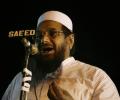
Saeed claimed, "Kashmiris had announced before the partition that it wanted to remain with Pakistan. But after partition India forcibly sent army to Jammu and Kashmir."

Former Pakistan foreign minister Hina Rabbani Khar on Wednesday said India and Pakistan should shed their "old baggage" as she made a strong pitch for the resumption of the Indo-Pak dialogue process.
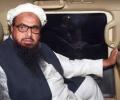
India expressed "outrage" over Mumbai terror attack mastermind Hafiz Saeed's imminent release.

India handed over "additional information" on Mumbai attacks to Pakistan High Commissioner Shahid Malik, who met Foreign Secretary Nirupama Rao in New Delhi on Friday. During the meeting held following a request by Malik, additional information on the 26/11 terror attacks including inputs on some of the key aspects and accused involved was given by Rao.
Mohammed Omar Madni, a suspected aide of Lashkar-e-Tayiba founder Hafiz Saeed, is likely to be questioned by the Mumbai police in connection with the July 11, 2006 serial train blasts case. "We are in touch with Delhi police authorities and after getting more information from them, we will send a team to interrogate him," Additional Director General (Anti-Terrorism Squad) K P Raghuvanshi said.
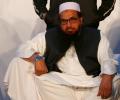
The perpetrators of the 2008 Mumbai attack, who shot dead 166 people, had confessed to details that should have been enough to hang him, but Pakistan enjoyed his anti-India rhetoric and let him spread his tentacles. A revealing excerpt from Khaled Ahmed's Pakistan's Terror Conundrum.

Inciting the public to raise funds for jihad (holy war) is not allowed to individuals or any organisation in Pakistan and is considered as treason, the Lahore high court has ruled even as it dismissed appeals of two terrorists convicted for raising funds for a proscribed terror outfit.

Chinese state television CCTV9 has highlighted the role of the LeT and its sponsors in Pakistan in this horrific attack which shook the world.
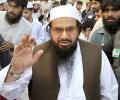
Hafiz Saeed, the mastermind of the 26/11 terror attacks in Mumbai, on Friday led Eid prayers at the famous Gaddafi stadium in Lahore, hours after Jamat-ud-Dawah chief tweeted that "time is near when those oppressed in Kashmir, Palestine and Burma will celebrate Eid in the air of Freedom".

The banned Jamaat-ud-Dawah head has hired Lahore-based law firm -- Mirza and Mirza Law Associates -- to file the petition.
Within 24 hours of Home Minister P Chidambaram's visit to Islamabad, the Pakistani government appears to have finally conceded to India's demand to act against the 26/11 masterminds, including Jamat-ud-dawa chief Hafiz Saeed.
Founder of Lashkar-e-Tayiba Hafiz Muhammad Saeed has been named in the charge-sheet on the terror attack in Mumbai for his suspected role in hatching the criminal conspiracy to carry out the terror strikes. The Mumbai police, which filed a 11,280-page charge-sheet on Wednesday before a magistrate, has named 59-year-old Saeed as the first accused wanted for his suspected role in planning the unprecedented attack on the country's financial hub.
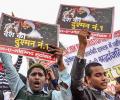
They are the first to be declared terrorists under the new anti-law, a home ministry official said.

A judicial team from Pakistan is scheduled to visit India on September 4 to continue Islamabad's probe into the 26/11 terror strike.
Actor Shah Rukh Khan's security, which had been withdrawn over a month ago, was restored on Sunday after reviewing the threat to him. The decision to rstore Khan's security has nothing to do with the statement of Pakistani Interior Minister Rehman Malik, the police said on Tuesday.

Hafiz Saeed, chief of terror outfit Lashkar-e-Tayiba and prime accused in the 26/11 Mumbai terror strike, has openly challenged India to prove that he is a terrorist.
India on Thursday said it has provided additional evidence against Lashkar-e-Tayiba founder Hafiz Saeed and other perpetrators of the Mumbai terror attacks to be used by Pakistani authorities to prosecute them, while expressing concern at the tardy pace of proceedings in the case.

The government last month had taken over the JuD's famous Muridke Markaz and Lahore's headquarters of Masjid Al Qadsia in Chauburji.
Jammu Kashmir Liberation Front chief Yasin Malik's passport is likely to be revoked by the government after he shared the stage with Mumbai terror attack mastermind Hafiz Saeed in Pakistan while protesting against Afzal Guru's execution.

Hafiz Saeed has confirmed that his organisation Jammat-ud-Dawa would contest the 2018 general elections under the banner of the MML.
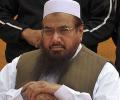
Dawn in its editorial said the move to arrest Saeed and four of his colleagues and place the Jamaat-ud-Dawa and the Falah-i-Insaniyat Foundation on further terror watch list will be "closely watched both inside Pakistan and abroad".
Saeed, has been moved to an unknown location.
61-year-old Rashid, leader of the Awami Muslim League of Pakistan, was detained soon after he arrived by an Emirates flight on Wednesday evening and was freed after five hours of interrogation.
Jamaat-ud-Dawaa chief Hafiz Saeed submitted a fresh application in a Pakistani court asking the judge to direct the government to defend him in a US lawsuit filed by relatives of victims of the 2008 Mumbai attacks.
The UN team to visit Islamabad for an assessment of Pakistan's compliance with the world body's sanctions regime.

Congress General Secretary Digvijaya Singh has questioned the Bharatiya Janata Party's stand on Kashmir, in the backdrop of the recent meeting between journalist Ved Pratap Vaidik and Mumbai attack mastermind Hafiz Saeed.
'Journalists and intelligence officials do a similar job -- collect information.' Three former RAW officials tell Vicky Nanjappa/Rediff.com that they see nothing wrong in Ved Prakash Vaidik meeting Lashkar-e-Tayiba terrorist Muhammad Saeed.

Police produced Saeed and his four aides before the board at Lahore registry of the apex court.

With Interpol issuing Red Corner Notice against Jamaat-ud Dawa chief Hafiz Saeed, India on Wednesday said the development vindicates its stand on his involvement in Mumbai terror attacks, and urged Pakistan to act on the basis of evidence collected 'painstakingly'.External Affairs Minister S M Krishna said the world should take note of the Interpol notice.
Unhappy over Pakistan's repeated claim about lack of evidence to prosecute Jamaat-ud Dawa chief Hafiz Saeed, India on Wednesday said it should not ask any more questions as enough proof has been provided in the dossiers on Mumbai attacks. "They should not ask any more questions. Everything is contained in the dossier," Home Minister P Chidambaram told reporters in New Delhi when asked to comment on Pakistan's claim that it does not have evidence to prosecute Saeed.
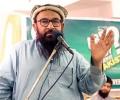
'I believe that the grounds for my listing are based on heresy and disinformation by the Indian government'
Union Home Minister P Chidambaram, while reacting to Pakistan's claim that India had not provided any evidence against Saeed, said "Zaki-ur-Rehman Lakhvi is one of the masterminds. There are others. We know their names and Pakistan also knows their names. If they do not bring the others to trial, then I would have to conclude, reluctantly and regretfully that they are dragging their feet," Chidambaram told media-persons in New Delhi.

India on Thursday expressed disappointment over the United States' refusal to extradite Lashkar-e-Tayiba terrorist David Headley even as it vowed to continue to pursue with its demand for bringing him here for his role in 26/11 Mumbai terror attacks.
Pakistan's Inter-Services Intelligence agency has claimed it had 'absolutely no role' in the 2008 Mumbai attacks and attempts to link the organisation and its ex-chiefs to the incident were a 'crude smear attempt', a media report said on Monday.

The Lashkar-e-Tayiba operative also revealed about his training while he deposed in front of a Mumbai court via video link.
A petition filed by Saeed and his aides Amir Hamza, Col (retired) Nazir Ahmed and Mufti Abdur Rehman in the Lahore High Court said they should be produced before the court so that it could see that they had been detained unlawfully.
The United States on Thursday slapped sanctions on Pakistan-based terror group Lashkar-e-Tayiba's top eight commanders, including Mumbai terrorist attack mastermind Sajid Mir and its founder Hafiz Saeed's son.
Ahead of Prime Minister Manmohan Singh's visit to Washington, the United States on Wednesday pressed Pakistan to act against perpetrators of the Mumbai attacks, including Jamaat-ud Dawa chief Hafiz Saeed, saying it wants to see results.
In yet another delaying tactic in the 26/11 Mumbai attack case, Pakistan has sent to India 47 questions regarding additional information on Lashkar-e-Tayiba operative David Headley and his activities during his multiple visits to the country.

India on Friday asked Pakistan to expeditiously bring to justice all those behind the Mumbai terror attacks, including Jamaat-ud-Dawa chief Hafiz Saeed and handlers of terrorists, including some Pakistani army personnel. Home Minister P Chidambaram said he will 'politely' tell Pakistan that the time has come to address issues concerning the deadly Mumbai terror attacks with the seriousness that they warrant.
